How to make reels without showing your face
· Aeyho Team · 11 min read
- Instagram reels
- faceless reels
- content planning
- small business marketing
- Instagram growth
On this page
Yes. Film the product, the work or the place, then put the point in a voice-over or in text on the screen. Your face is not one of the things Instagram asks for. A stranger still has to understand the reel in the first 3 seconds, the same test as any other reel.
What goes into a reel with no face?
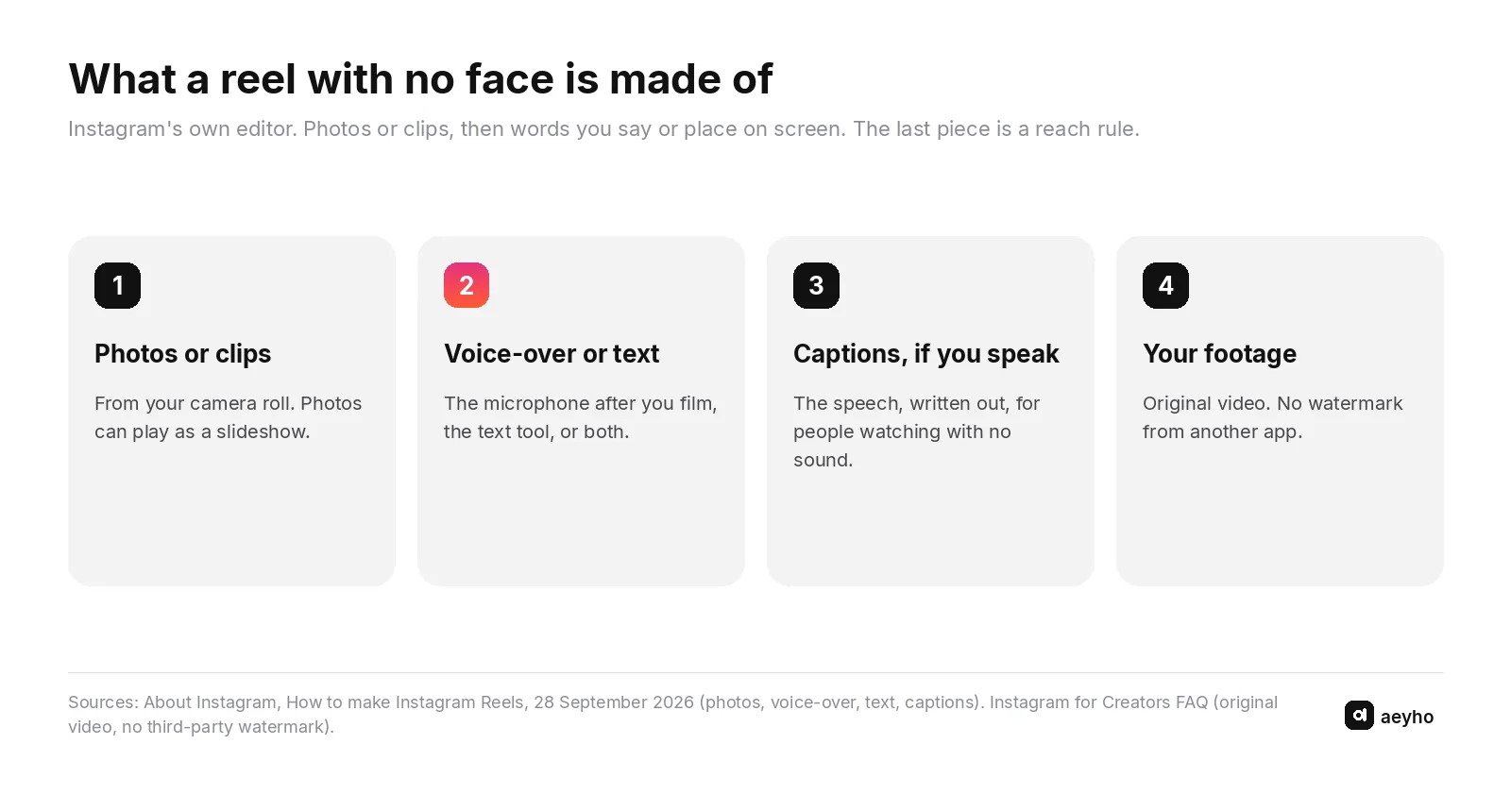
Four pieces. You can shoot all of them with the phone pointed at the counter.
| Piece | Where it comes from | What it is for |
|---|---|---|
| Photos or clips | Your camera roll | What a stranger sees. A reel can be photos only. They play as a slideshow. |
| A voice-over | The microphone, after you film | The point, said while the camera stays on the work. |
| Text on the screen | The text tool | The line in the first frame, and anything the voice does not cover. |
| Words under the video | The caption on the share screen | Context, and a reason to send a message. |
How do you make one?
This is the path in Instagram's own editor, from its guide of 28 September 2026.
- Start from what you already have. Record clips, or choose photos and video from your camera roll. The guide says a reel can be photos alone. They play as a slideshow, and you add the audio after.
- Record the voice-over on the editing screen. Tap the microphone. Instagram describes it as the way to narrate a tutorial or tell a story over the clips. The camera stays on the work.
- Put one line of text on the first frame. The guide calls that line the reel's headline, and suggests a question first, with the answer a few seconds later.
- Add captions only if someone speaks. Captions write out the speech, including for people watching with the sound off. Text you place yourself is a separate tool. If nobody speaks, the text tool is enough.
- Keep the opening line off the bottom of the frame. Meta's Reels guide says to leave the bottom 35% of a vertical 9:16 video free of text, logos and other key elements, because the buttons cover it. That is layout, from a guide that covers Reels and ads. It is not a ranking score.
- Choose a cover that shows the work. Your face will not be the thumbnail on the grid.
Text-to-speech can read the on-screen words if you would rather not record. Instagram's Help Center says it is English only, and only in some countries: the United States, the United Kingdom, Canada, Australia, New Zealand, Singapore, Ireland and India. Otherwise, record the voice-over, or let the text carry the reel.
How long should a faceless reel be?
Under 3 minutes if you want it shown to people who do not follow you, and short enough that the point lands before they leave.
The creator FAQ says Instagram recommends videos to people who do not follow you when the video is 3 minutes or less. The September 2026 guide splits that range into three bands: a quick line (3 to 15 seconds), tutorials and most formats (15 to 60, which it calls the sweet spot), and a longer how-to (up to 3 minutes).
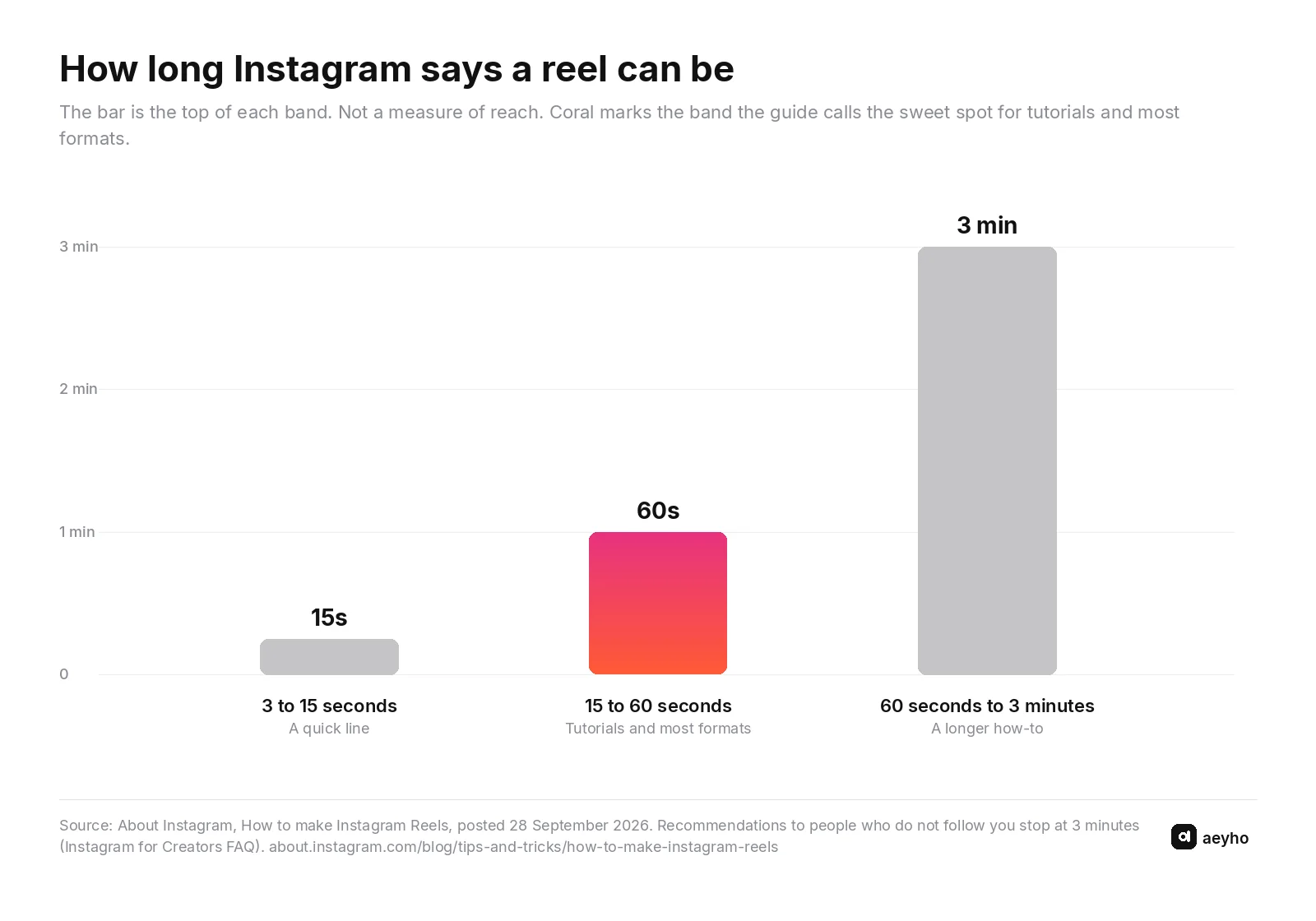
A product, a price and one reason fits in the middle band. A job with several steps can use the long one.
The first 3 seconds are a separate rule. The FAQ says to make them count, so people do not move on. Instagram's February 2025 note says to watch View Rate in Insights: the share of viewers still watching after those 3 seconds. On a faceless reel, those seconds are the text line and the first shot. A slow pan of a counter, with the point waiting in the voice-over, loses people before the voice starts.
Should it have a voice-over?
Usually, yes. Keep the hook on screen too.
Instagram's February 2025 post says audio can catch people who do not follow you. The creator FAQ says trending audio can affect distribution. A voice-over can sit over a track. Use the volume slider so the voice stays louder than the music.
Meta's guide to Reels ads, 7 November 2024, says "Over 75% of Reels views on Instagram are sound on." It does not give a more exact figure, or how it was counted. Record the voice. Do not bet the reel on sound alone.
The mute figure people repeat is older, and it measures something else. In May 2022 Instagram said one third of video plays were with the sound off. That was all video, not reels. The opening line of text still matters: some views are silent, and the first frame has to work before the audio starts.
Does skipping your face cost you reach?
No source we checked says it does. The creator FAQ lists what can limit distribution. A missing face is not on it.
- A watermark from another app. Instagram says to ditch it.
- Unoriginal video. Original content is what it says gets the best reach.
- Over 3 minutes. Not recommended to people who do not follow you.
- A soft upload. Upload the highest resolution you can.
- Clickbait and contests. Those can fall outside the recommendation guidelines.
The same page calls reels the best way to reach new audiences, if video is how you post. Feed ranking does not prefer reels over photos.
Use footage you shot. In April 2024 Instagram said a new voice-over can stop a clip counting as an identical copy of someone else's. That describes how copy detection works. It is not a reason to narrate a video you downloaded. Accounts that repeatedly post content they did not create, or did not materially change, are kept out of recommendations. Your own work, a packed order, the counter at open: that is the original.
A price list, or anything someone saves, still belongs on a carousel. Which post should be which is in reels or carousels.
What are 30 faceless reel ideas?
Point the phone at something you already do this week. Each line is one reel. The picker steps through them if you do not want to read all 30.
Pick one to film this week
Filter by what you can point a phone at, then step through. The same 30 ideas are listed under this.
The product · 1 of 30
Three angles of one product on a plain table. The voice-over says who it is for, in one sentence.
Runs in your browser. Nothing you tap is stored or sent.
The product
- Three angles of one product on a plain table. The voice-over says who it is for, in one sentence.
- The product next to something familiar, so the size is obvious, with the measurement in text.
- Price, what is included, and how long it takes, as three lines over the product.
- The unboxing a customer gets, from closed box to the thing inside. Hands only.
- Two versions side by side. Say which to pick, and the one reason.
- One detail a photo usually misses: the stitch, the crumb, the label or the hinge.
The work
- Overhead, about 15 seconds, one job from start to finish. Text labels each step.
- The same shot before and after. The voice-over is the decision that made the difference.
- The step people always ask about, slowed down, with how long it takes in text.
- An hour of work as a short time-lapse, and one sentence on what you check halfway.
- The tools or ingredients for one order, and the one you would not skip.
- A mistake you caught, then the fix, and what you look for so the customer does not have to.
The place
- From the door to the counter. Text says what to do on arrival.
- What is on the shelf this week, close up, with the price in text.
- The work surface at open, then the same surface at close.
- The sign, the thing you sell, then the hours. Three shots.
- Where a finished order waits, and the words a customer should look for.
- The one corner of the shop that explains the business better than the logo.
Proof
- A real customer message on screen, while you make what they asked for. Leave the name off unless they agreed.
- One review, read as a voice-over, over the finished work.
- The question you were asked this week, answered in text over the shot that answers it.
- A number from your own counter, with the period it covers. Orders, sell-outs or bookings.
An answer
- Bring this, not that, for a first visit. Two short lines, the place behind them.
- How long it takes, from order to ready, as a simple timeline over the work.
- What it costs, in three lines, over the thing itself, including what changes the price.
- Who it is not for, said plainly, over the product.
- One thing people get wrong, shown, then the right way.
- The same product, three uses. One use, one sentence, one shot.
- A photo you already posted, retold: a tighter first line, then the detail the photo could not hold.
- One job across three reels: the start, the hard part, the handoff. Each one makes sense on its own.
Idea 22 only works with a number you actually have. Do not borrow one. Idea 29 starts from a photo you posted, not from someone else's.
What does a week of them look like?
An illustration written for this post. Not a real shop, and not a plan anyone ran.
Example: a neighborhood print shop
The shop sells posters, menus and same-day printing. Orders arrive by message. The owner will not stand in front of the camera. The week is three reels and one carousel, the same starting pace as how many reels a week.
| Day | What the camera sees | What the viewer gets |
|---|---|---|
| Monday | A poster going through the printer | A voice-over on what same-day means, including the cut-off |
| Wednesday | Three paper stocks on the counter | Text: which one for a menu, a window, a wedding invite |
| Friday | Hands sliding a print into a tube | The request, read out, with the price in text at the end |
| Saturday | A carousel, not a reel | Sizes, paper, prices, and how to send a file |
Every clip is shot during a job that was happening anyway. If you want to see whether one of these works before your followers do, Instagram's trial reels (the same February 2025 post) let you share a reel only with accounts that do not follow you, then decide whether followers see it.
You can see how Aeyho plans a month, with the format chosen per idea, and reels and carousels it has made.
How do you tell if they are working?
Wait four weeks. Compare a faceless reel with your earlier reels, not with an account that films a person.
- Reach from people who do not follow you. That is the job. If it is flat, change the first 3 seconds before you change the format.
- View rate after 3 seconds. Instagram points you at this in Insights. If people leave at once, the opening line is the problem, not the fact that you stayed off camera.
- Saves, profile visits and messages. A save means someone wanted the post again. A message means it did the thing a business posts for.
No source we checked publishes a good view rate for a small shop. Your last month is the comparison that fits. If one reel does none of this, replace that reel. Keep the ones where the phone was pointed at the work.
FAQ
How do I make Instagram reels without showing my face?
Film the product, the work or the place, then add a voice-over or text. Instagram's guide says photos from your camera roll can play as a slideshow.
Can I make a reel from photos only?
Yes. Upload them from your camera roll. They play as a slideshow. Add music, a voice-over or text.
Do faceless reels get less reach?
No source we checked says so. The creator FAQ names other limits: a watermark, unoriginal video, low resolution, and reels over 3 minutes.
Do I need a voice-over if the text is already on screen?
Use both when you can. Meta says over 75% of Reels views are with the sound on, and does not publish the exact share. Keep a line of text on the first frame anyway.
Can I use text-to-speech instead of my own voice?
Yes, where Instagram offers it. Text-to-speech is English only, and only in some countries, including the United States. Elsewhere, record a voice-over or rely on the text.
What should I avoid so a reel with no face still gets recommended?
Footage you shot, no watermark from another app, and 3 minutes or less. Instagram recommends original video in that length to people who do not follow you. Accounts that repeatedly post other people's clips can be kept out of recommendations.
If the filming is the part that does not happen, Aeyho plans a month of reels and carousels, writes them and makes the finished pieces from photos, clips and a voice-over, with no one on camera, for a flat $29 a month on Starter or $59 on Pro. Taxes may apply at checkout depending on your country. You post them yourself.
Last checked: 10 November 2026.
Sources
- Instagram for Creators, Frequently asked questions (checked 10 November 2026): https://creators.instagram.com/faq
- About Instagram, "How to make Instagram Reels: the complete 2026 guide" (posted 28 September 2026): https://about.instagram.com/blog/tips-and-tricks/how-to-make-instagram-reels
- Instagram for Creators, "Helping creators of all sizes break through" (26 February 2025): https://creators.instagram.com/blog/helping-creators-of-all-sizes-break-through
- Instagram for Creators, "Helping Creators Find New Audiences" (30 April 2024): https://creators.instagram.com/recommendations-and-originality
- Instagram Help Center, "Add text and text-to-speech to your reel on Instagram" (checked 10 November 2026): https://help.instagram.com/3544819209117630
- Meta for Developers, "Unlock the Power of Reels Ads" (7 November 2024): https://developers.facebook.com/blog/post/2024/11/07/unlock-the-power-of-reel-ads/
- Meta for Government and Nonprofits, Reels (checked 10 November 2026): https://www.facebook.com/government-nonprofits/resources/reels
- About Instagram, "Advancing Accessibility on Instagram" (19 May 2022): https://about.instagram.com/blog/tips-and-tricks/advancing-accessibility-on-instagram